
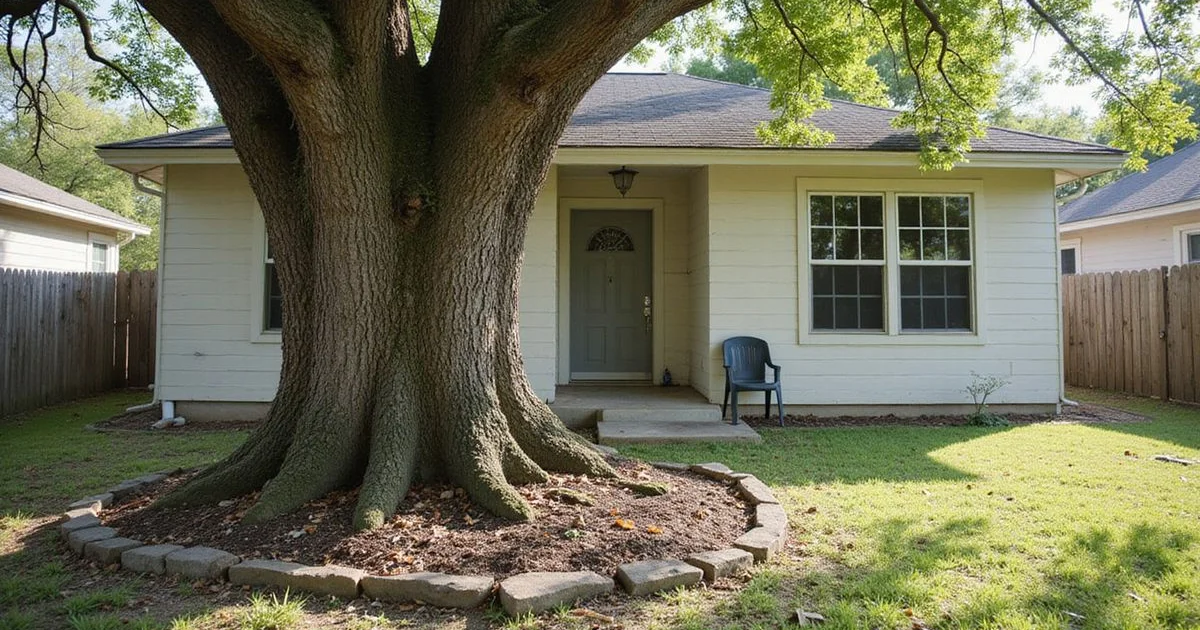
The Short Answer
Slab movement in Houston is, in the great majority of cases, about moisture varying unevenly in expansive clay beneath a foundation.
Everything else on this page is a list of the things that make moisture uneven, plus the two directions the resulting movement takes. Our slab foundation repair page covers what is done about it once the cause is understood.
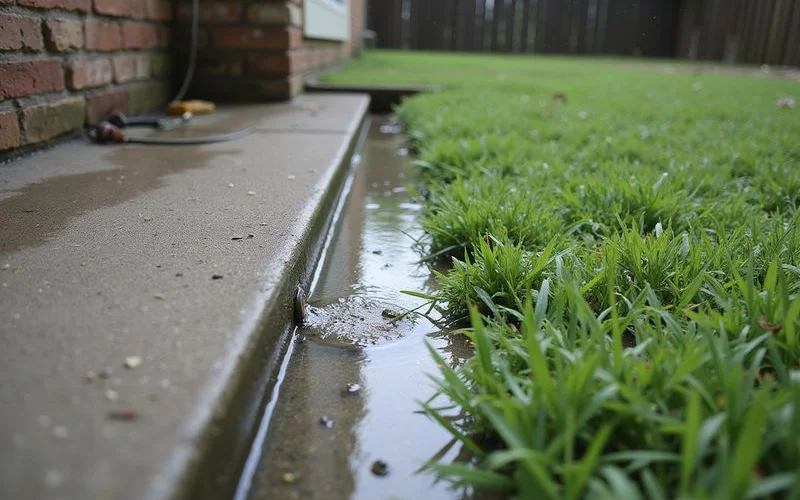
Moisture Variation in Expansive Clay
Clay soils with high shrink-swell potential expand when they take on water and contract when they dry. Across a residential lot, that volume change moves the soil supporting a slab.
Uniform change moves the whole house together and produces no distress. Differential change — one part of the foundation supported differently from another — is what forces a structure to span a difference it was not designed to span.
The clay soil mechanics guide covers the underlying behaviour in detail.
What Makes Moisture Uneven
Sun and shade. South and west elevations bake in Houston afternoon sun and dry faster than a shaded north side. Same house, different moisture, all summer.
Drainage and discharge. Grade falling toward the house instead of away. Downspouts emptying at the slab edge, delivering concentrated roof water repeatedly into one spot. Water standing after rain on one elevation and nowhere else.
Irrigation. Frequently generous in a front bed and absent down a side yard. That is a moisture differential on a timer.
Trees and large planting. A mature tree draws a substantial volume of water from soil, producing sustained localised drying near one part of the slab. Our tree roots and root barriers guide covers this specifically.
Hardscape. A patio or driveway shields the soil beneath it from rainfall and evaporation alike, so it behaves differently from adjacent open ground.
Under-slab plumbing leaks. A leak saturates soil continuously in one zone while the rest of the lot cycles normally. This is one of the more common single causes of localised movement and is covered in the slab leaks guide.
Fill, Grading, and Construction History
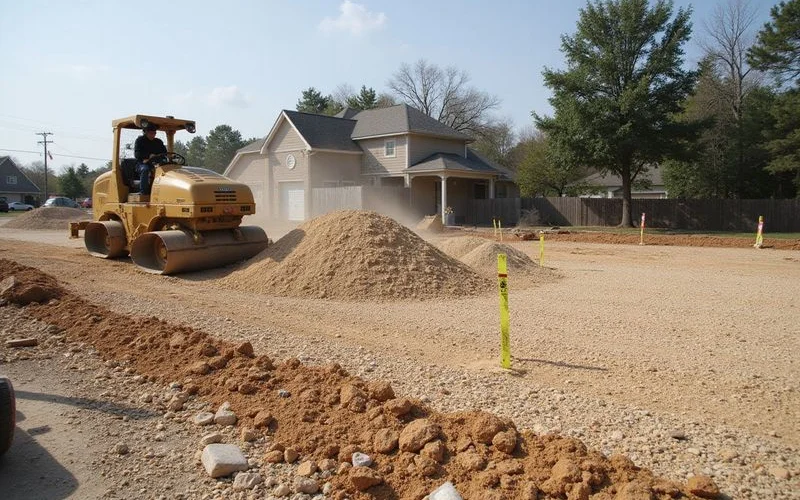
The material immediately beneath a slab on a developed Houston lot is frequently not native soil at all. Subdivisions are cut, graded, and filled during development.
Fill placement and compaction history matter enormously and vary between sections of the same development, sometimes between neighbouring lots. Poorly consolidated fill continues settling for years after construction, quite independently of moisture cycling.
This is why newer homes are not exempt. A house built in the last decade on graded fill over expansive clay can show distress that a fifty-year-old house on undisturbed ground does not. Age tells you very little. Support consistency tells you a great deal.
Original construction irregularities also feature. Not every slope in a floor is movement — some floors were poured that way, and an evaluation records the difference between an original irregularity and a developing one where the evidence allows.
Settlement Versus Heave
Two directions, two different problems.
Settlement is downward. Soil has shrunk during a dry period or been washed out by erosion, support has been withdrawn, and the foundation drops at that location. The typical elevation pattern is a low point, often at a corner or along one edge, with distress radiating from it.
Heave is upward. Soil has taken on water and swelled, pushing up. In Houston it commonly shows as the centre of a slab sitting high relative to a perimeter that has dried, or as a localised area lifting where water has concentrated.
They matter because the response differs. Piering a low corner addresses settlement. A high centre produced by heave is a different situation, and treating it as settlement leads to the wrong scope. This is precisely why the elevation survey pattern is the starting point rather than the crack you happened to notice.
Both can be present on the same house at different points.
What About Subsidence and Faults?
They come up constantly in Houston, and they are real, but they rarely explain a specific house.
Regional subsidence lowers the land surface across broad areas. Where it acts uniformly beneath a lot, the house descends with it and stays level.
Published fault traces describe approximate regional geology at a scale that cannot resolve an individual property.
Neither explains why one house on a street shows distress and the identical house next door does not. Property-scale moisture variation does, routinely.
Why the Cause Matters to the Repair
Establishing the mechanism is not academic. It changes the scope.
If the driver is a drainage problem, drainage correction belongs in the conversation alongside any structural work, because piering a slab while water continues pooling against one elevation addresses the effect and leaves the cause running.
If the driver is an under-slab leak, the sensible sequence usually starts with a plumbing assessment, because repairing the structure while a line still leaks underneath is working in the wrong order.
If the driver is root-related desiccation, a root barrier may be worth discussing.
And if the readings show seasonal cycling rather than progression, the reasonable answer may be to monitor and re-measure rather than to repair at all.
This is why our evaluation records site conditions alongside the elevation survey. The measurement establishes what is happening. The site conditions suggest why.