
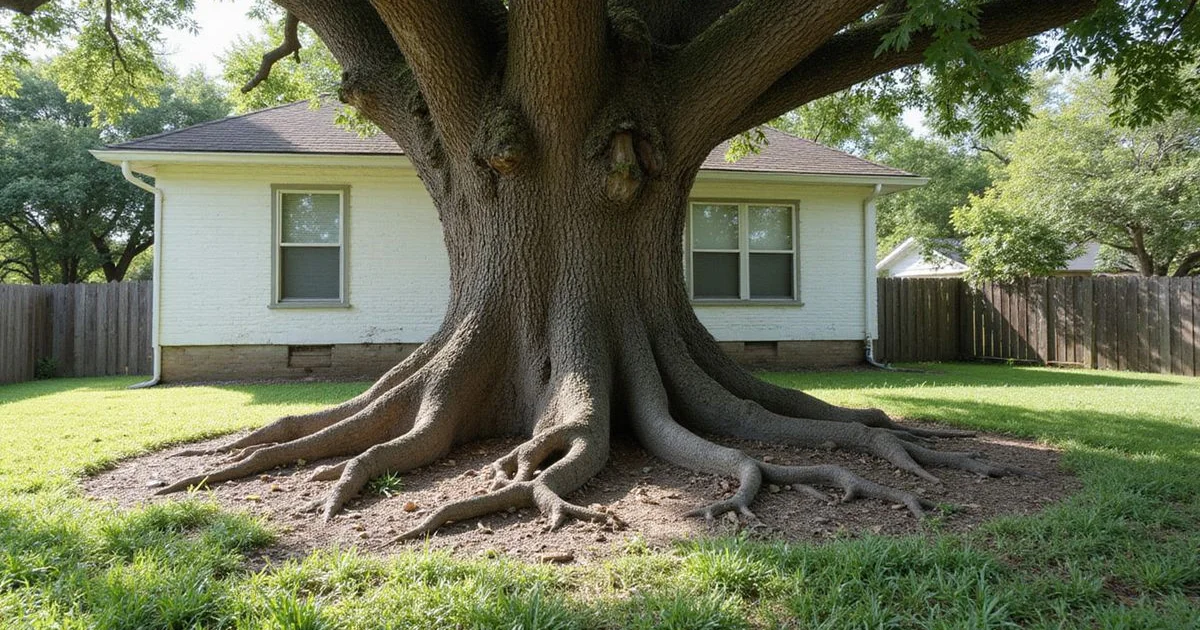
The Mechanism: Moisture, Not Force
The image most homeowners have is a root pushing against concrete and cracking it. That does happen occasionally — usually to flatwork like sidewalks and driveways rather than to a house slab — but it is not the main way trees affect foundations in Houston.
The dominant mechanism is moisture withdrawal. A mature tree moves a substantial volume of water out of the soil through its roots and out through its leaves, particularly during hot, dry weather when it needs the most. Soil in the root zone dries as a result.
In expansive clay, drying soil contracts. Contracting soil near a slab can withdraw support at that location. And because a tree affects the soil near it and not the soil at the opposite corner of the house, the effect is localised — which is exactly the differential condition that distresses a structure.
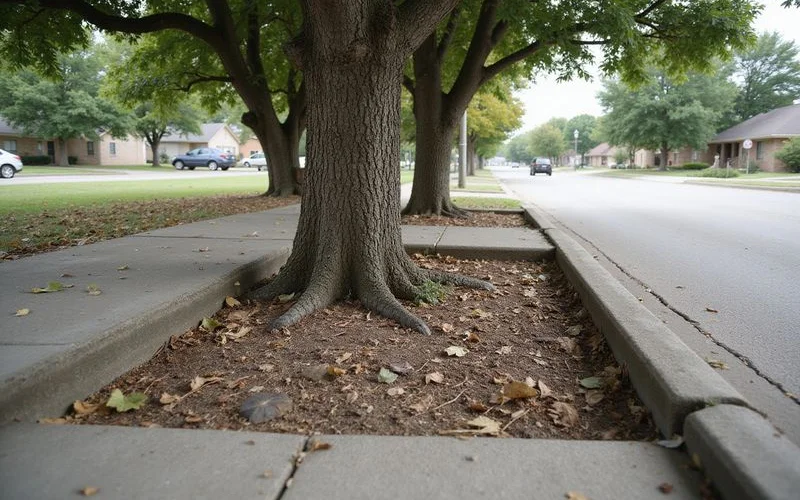
Why Houston Makes This Worse
Two features of this region combine.
The trees. Live oaks, water oaks, and other large species are common in Houston neighbourhoods, with substantial canopies and correspondingly substantial water demand. Many of the oldest and most attractive residential streets in the city are shaded by them.
The soil. Expansive clay responds far more dramatically to moisture loss than sandy soil does. The same tree in sandy soil would draw the same water with far less volume change in the ground.
Add a Houston summer dry spell and the effect concentrates. Soil under a canopy close to a house can dry considerably more than soil on the opposite elevation over the same period.
How Root Barriers Work
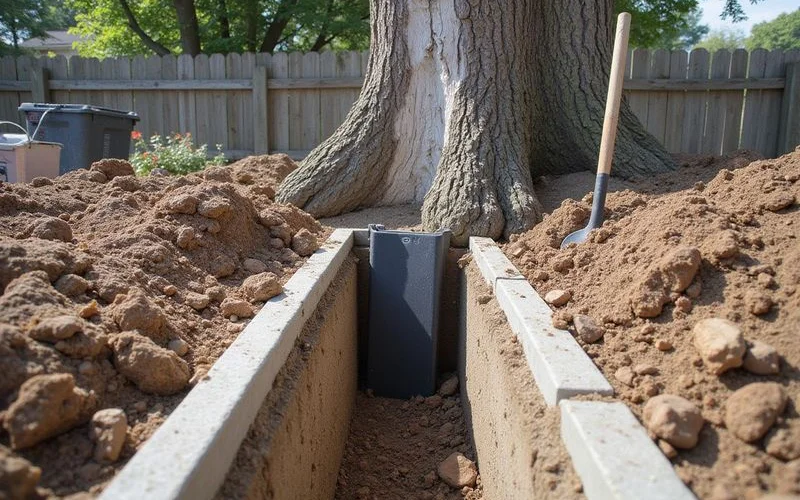
A root barrier is a vertical panel, commonly high-density polyethylene, installed in a narrow trench between a tree and a structure. It extends down into the soil and interrupts the lateral spread of roots in that direction.
The idea is straightforward: roots meeting the barrier are deflected downward or sideways rather than continuing toward the foundation, reducing the root density in the soil immediately supporting the slab, and with it the moisture withdrawal at that location.
Installation involves trenching along the run between tree and structure, setting the barrier vertically to an appropriate depth, and backfilling. Depth and length are judgement calls based on the tree, the soil, and the geometry.
When a Barrier Helps and When It Does Not
It may help where a large tree sits close to a structure, the soil on that elevation is noticeably drier than elsewhere during dry spells, root activity is evident near the foundation, and the distress pattern in the elevation survey corresponds with the tree’s position.
It will not help where the movement is driven by something else entirely — drainage, fill consolidation, an under-slab leak, or seasonal cycling affecting the whole house evenly. Installing a barrier in those situations spends money on the wrong problem.
It also will not reverse movement that has already occurred. A barrier is a forward-looking measure that changes conditions going forward. If support has already been lost, restoring it is a structural question, covered on our slab foundation repair page.
Honest Limits
Worth stating plainly:
- A barrier addresses one factor. Drainage, irrigation, fill, and seasonal cycling continue regardless.
- Roots can grow under a barrier that does not extend deep enough, and around one that is not long enough. Extent matters.
- A barrier affects the tree. Interrupting root spread on one side is not nothing from the tree’s point of view, and its long-term health is worth considering.
- Trenching near a tree is itself root disturbance. The installation cuts roots to place the panel.
- There is no evidence a barrier makes a structure immune to movement, and nobody should present it that way.
Should You Remove the Tree?
Rarely the first answer, and worth thinking about carefully.
Removing a mature tree has its own consequences. The tree has been drawing water from that soil for years, and the soil has reached an equilibrium with that demand. When the demand stops, the soil takes on moisture it was not previously holding — and swelling soil moves a foundation just as effectively as shrinking soil. Heave following tree removal near a structure is a documented phenomenon.
There is also the obvious point that a mature shade tree in Houston has real value, for the property and for the summer electricity bill.
Where removal is genuinely being considered, it is worth involving an arborist alongside whatever foundation advice you are getting, and thinking about the moisture consequences rather than treating removal as a clean solution.
The Alternatives Worth Considering First
Consistent watering. Keeping soil moisture more even during dry spells directly addresses the mechanism. Our foundation watering guide covers placement and timing.
Drainage correction. Where one elevation is wet and another dry, drainage and water management addresses the wet side of the same differential.
Even irrigation. Adjusting coverage so the tree side is not the only part of the house that stays dry.
Canopy management. Reducing canopy reduces water demand, though it requires arborist judgement rather than enthusiasm with a saw.
What to Do If You Are Concerned
Observe first. During a dry spell, look at the soil near the slab on the tree side and compare it with the opposite elevation. Visible cracking and shrinkage on one side only is meaningful information.
Then measure. A foundation evaluation records the floor plane, and the elevation pattern either does or does not correspond with the tree’s position. That correspondence — or its absence — is what turns “there is a big tree near my house” into an actual finding.