
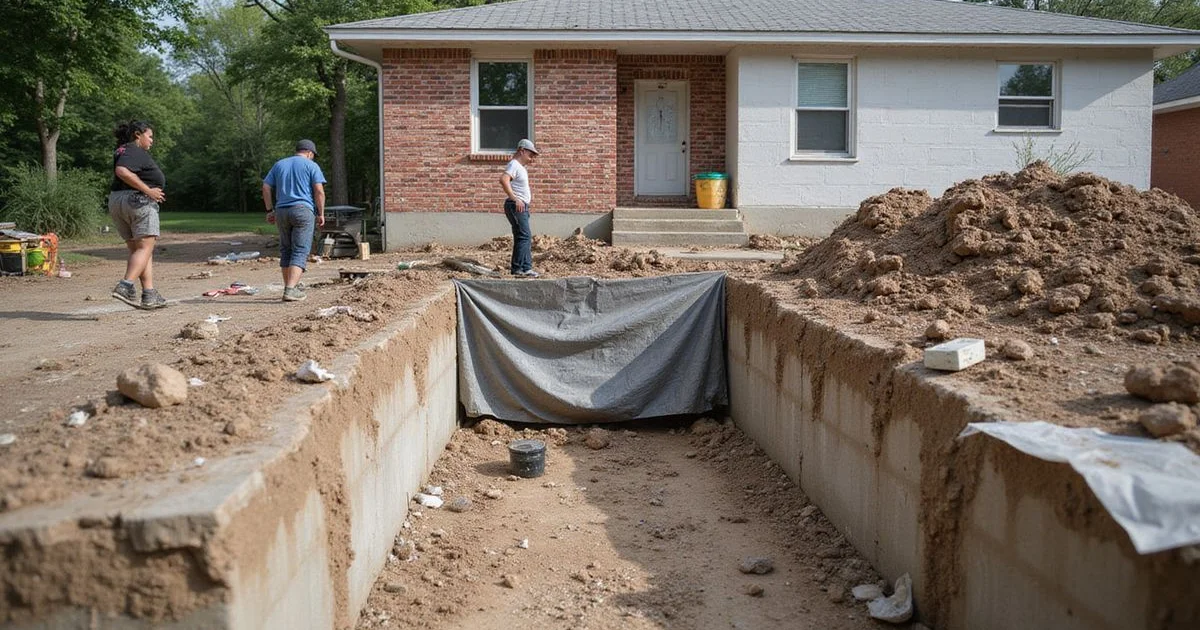
The Honest Starting Point
For typical residential foundation distress in the Houston area, repair is the answer in the overwhelming majority of cases. Replacement is a specific scenario, not a common one, and a homeowner reading about foundation problems should not assume they are facing it.
That is worth saying up front because the internet is full of worst-case framing. Our slab foundation repair page describes what repair actually involves, and this guide explains where the line between the two sits.
What Repair Addresses
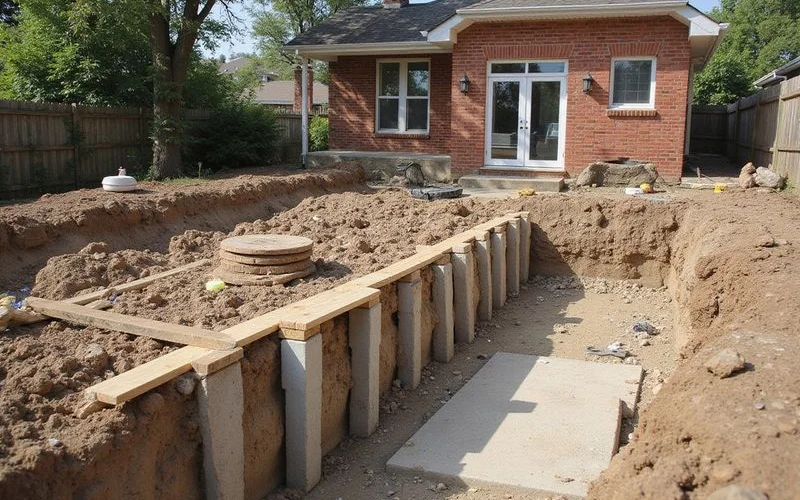
Repair works on the support beneath a slab. The concrete itself is generally fine; the soil under it has stopped providing even support.
The work transfers load from unstable near-surface soil to a more stable bearing layer through installed piers, then lifts the slab in a controlled way back toward its intended plane within the structure’s tolerance. The house stays where it is. You generally keep living in it.
This is the right answer when the problem is support rather than the slab itself. Cracked, yes — slabs distressed by differential support crack, and that is expected. Structurally compromised as a unit, no.
What Replacement Means
Replacement means demolishing the existing slab and constructing a new foundation. In practical terms, on a home, that involves:
- Removing or supporting the structure above
- Demolishing and removing the existing slab
- Preparing the subgrade
- Forming, reinforcing, and pouring a new foundation
- Rebuilding what was removed
- Displacement of the occupants for the duration
It is a construction project rather than a repair, with a cost and a timeline to match.
Where the Line Falls
Repair generally applies where:
- The slab is intact as a structural unit, whatever cracking is present
- The distress reflects lost or uneven support rather than slab failure
- Bearing material is reachable at a practical depth
- Access allows pier installation
- The structure will tolerate a controlled lift
Replacement enters the conversation where:
- The slab is structurally compromised rather than merely cracked
- Deterioration of the concrete or reinforcement is extensive
- Original construction was fundamentally inadequate for the loads on it
- The structure is being substantially rebuilt anyway for other reasons
- Repeated repair attempts have genuinely failed for identifiable reasons
That last one deserves care. A repair that did not achieve what was expected is more often a scope problem — the wrong locations, the wrong method, or an unaddressed underlying cause like a leak or a drainage failure — than evidence that repair cannot work.

Side by Side
| Repair | Replacement | |
|---|---|---|
| What it addresses | Support beneath the slab | The slab itself |
| Structure above | Stays in place | Supported or removed |
| Living in the home | Usually possible | Not during the work |
| Typical duration | Days to weeks | Months |
| Cost | Substantially lower | Substantially higher |
| Restoration | Landscaping, some interior patching | Rebuilding |
| How common residentially | Very | Rare |
Cost Drivers for Each
Repair is driven by pier count and placement, depth to refusal, method, access, interior versus perimeter work, restoration, plumbing, and permits. Our cost-factor guide works through them.
Replacement is driven by the size of the footprint, demolition and disposal, temporary support or relocation of the structure, subgrade preparation, forming and pouring, the rebuild of anything removed, and the cost of displacement during the work.
The difference between them is not marginal.
Questions to Ask If Replacement Is Recommended
If a contractor tells you your slab needs replacing, these are fair and necessary questions:
- What specifically makes repair unsuitable here? The answer should be about the slab’s structural condition, not about the amount of movement.
- What did the elevation survey show, and can I see it?
- Has an engineer assessed this? Replacement is a substantial recommendation and an independent stamped opinion is reasonable to want.
- What would repair achieve, and why is that insufficient?
- What is the cost of each path, fully scoped?
Then get a second opinion. Replacement is a large enough decision that a second view is simply prudent, and any contractor confident in their assessment should expect you to seek one.
Where an Engineer Fits
For a genuine repair-versus-replacement decision, an engineering assessment is worth considering. A licensed professional engineer provides an independent structural opinion, separate from any contractor’s commercial interest in the outcome, and can produce a stamped report.
That matters here more than in most situations, because the two paths differ so dramatically in cost and disruption. Our contractor versus engineering assessment guide explains where each fits.
What We Do
Our evaluation produces the elevation readings and distress mapping that any defensible recommendation is built on. Where the findings support repair, the proposal covers method, scope, exclusions, schedule, warranty, and payment terms.
Where we believe a situation genuinely warrants an engineer’s opinion before a decision, we say so. And we do not recommend replacement, because it sits outside our scope and because recommending it would require certainty about slab condition that a non-destructive evaluation cannot provide.