
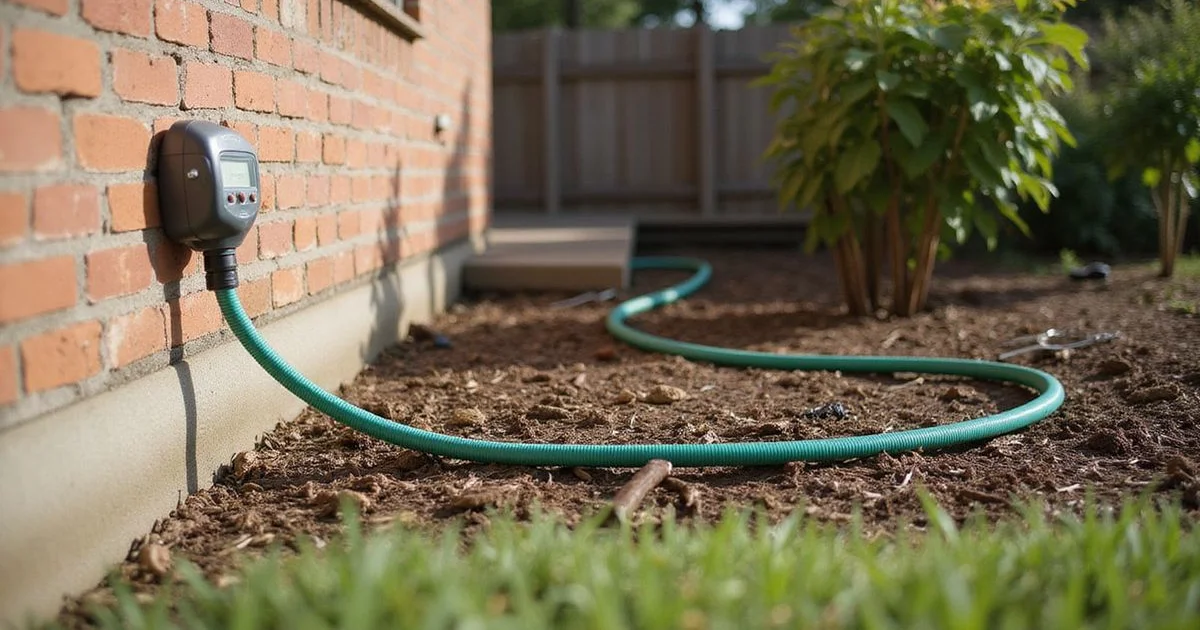
Why Anyone Waters a Foundation
It sounds odd the first time you hear it. You water plants, not concrete.
What you are actually watering is the soil supporting the concrete. Houston’s expansive clay shrinks as it dries, and shrinking clay pulls away from and withdraws support beneath a foundation. During a hot, dry Houston summer that happens fast and, crucially, it happens unevenly — the sunny south and west elevations dry out faster than the shaded north side, and a bed with mature planting draws moisture faster than bare lawn.
Uneven drying means uneven support. That is the mechanism this practice addresses. Our guide on why Houston clay soils move foundations covers the underlying mechanics.
The objective is consistency, not wetness. You are trying to stop the soil swinging between bone-dry and saturated, not trying to keep it wet.
Placement
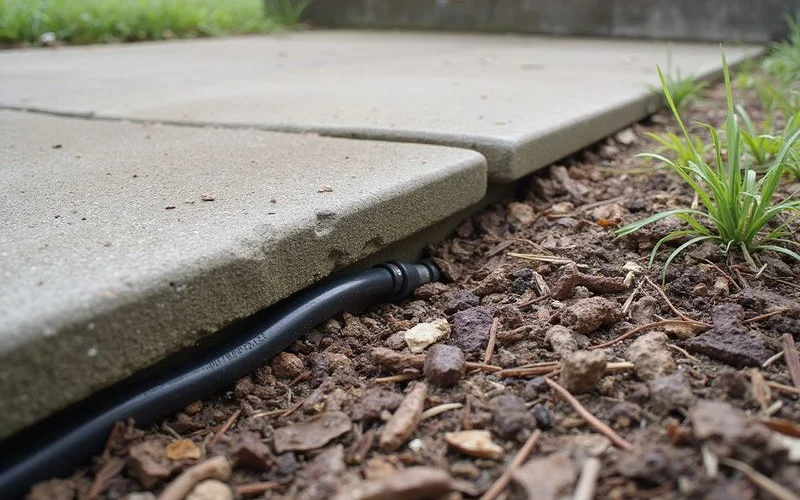
Distance from the slab. Set the hose a short distance out from the foundation edge rather than hard against it. Directly against the slab concentrates water in a narrow band and can push moisture where you do not want it. Too far out and you are watering lawn rather than the soil that supports the structure. Somewhere in between is the target — far enough to wet a band of soil, close enough that the band is the one that matters.
Coverage. Run it around the perimeter, and pay particular attention to the elevations that dry fastest. In Houston that is usually south and west facing walls and anywhere with full afternoon sun. Corners dry from two directions at once and are worth including.
Under beds. Where there are planting beds against the house, running the line under mulch works well — the mulch reduces evaporation and keeps moisture in the soil rather than in the air.
What to avoid. Do not aim water at the foundation itself, do not create a pond against the slab, and do not run a line across a spot where water already collects.
Timing
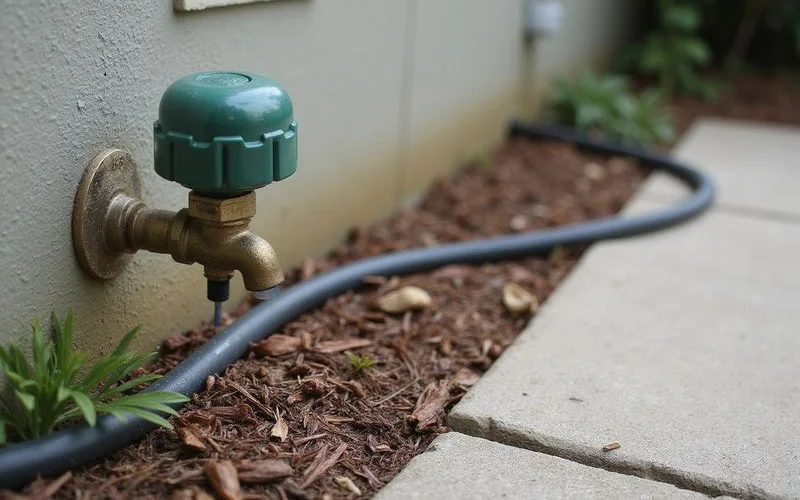
Use a timer. This is the single biggest practical improvement most people can make. A basic mechanical or battery hose timer costs very little and removes the two failure modes: forgetting entirely, and leaving it running for three hours.
Short and frequent beats long and rare. The goal is holding moisture steady, not soaking deep. Frequent short sessions keep the band of soil around the foundation in a narrower moisture range than an occasional drenching followed by days of drying.
Early morning or evening. Houston summer evaporation in the middle of the day is substantial, so watering at midday wastes much of it.
Start before the cracks appear. By the time soil is visibly pulling away from the slab, the shrinkage has already happened. Starting a routine as the dry stretch begins is more useful than reacting to visible drying.
How Much Is Enough
There is no universal number, and any source giving you one without knowing your soil, your shade, and your conditions is guessing.
What works is checking the soil rather than following a schedule blindly. Push a screwdriver or a probe into the soil in the watered band. If it goes in with reasonable ease, the moisture is reasonable. If it will not go in, the soil is dry. If it comes out with mud on it, you are overdoing it.
Check in two or three places around the house, because the whole point is evenness. If the north side probes easily and the west side is like concrete, that difference is what you are trying to close.
Overwatering Is a Real Problem
More is not better, and this deserves its own heading because homeowners who take up the practice sometimes overshoot.
Excessive water softens soil, and softened soil supports less well than firm soil. In clay it can cause heave, pushing upward rather than settling downward, which distresses a structure just as effectively in the opposite direction. It can saturate a crawl space on a raised foundation, driving wood rot. And water applied heavily against a foundation has to go somewhere.
Damp, consistently. Not soggy.
Tapering at the End of the Season
When Houston’s rain returns, do not simply switch the timer off on the day of the first storm.
Going from a daily routine to nothing, in the same week the wet season arrives, produces a sharp moisture swing — precisely what the whole practice exists to prevent. Reduce frequency gradually over a few weeks as rainfall becomes reliable.
The same applies in reverse in spring. Start gently as things dry rather than jumping straight to a full routine.
What Watering Does Not Do
- It does not repair movement that has already occurred
- It does not compensate for a drainage problem — the wet side of your house does not need watering, it needs drainage
- It does not overcome poorly consolidated fill or original construction issues
- It does not fix an under-slab leak, which saturates soil continuously in one zone
- It is not a substitute for measurement if you have already noticed distress
Watering manages one condition. It is genuinely worth doing in Houston’s climate, and it is inexpensive. It is not a repair.
If you have noticed cracking, sticking doors, or a floor slope, a foundation evaluation is the step that establishes what is actually happening. Our maintenance guide covers the rest of the seasonal routine.