
Why Water Management Matters Here
Houston sits on expansive clay. Clay swells when wet and shrinks when dry, and that volume change moves the soil supporting a foundation. When the change is uneven around a house, the support becomes uneven.
Drainage is one of the few levers a homeowner has over that. A property where roof water discharges at one corner, where grade falls toward the house at the back, and where one elevation stays saturated while another bakes dry has a built-in moisture differential.
The objective is consistency. Not dryness — consistency. Our drainage solutions page covers the service; this guide covers the components.
The Components
French drain
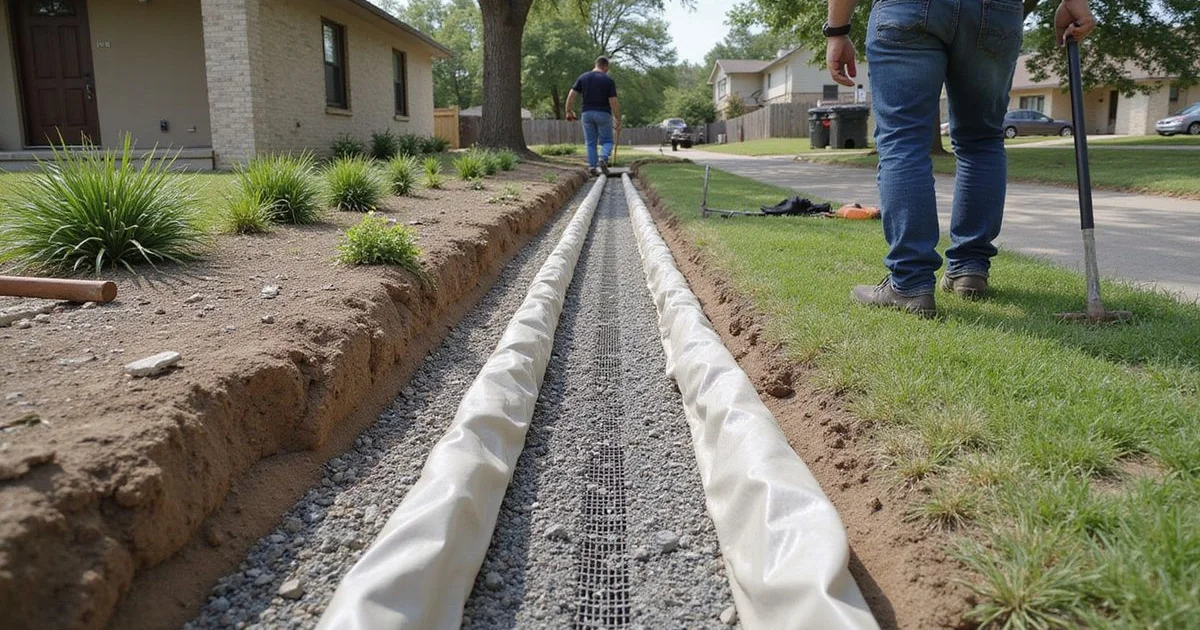
A trench containing a perforated collection pipe bedded in washed aggregate, wrapped in filter fabric. Water in the surrounding soil enters the aggregate, finds its way into the pipe through the perforations, and flows to an outlet.
Why the details matter:
- Filter fabric keeps fine soil out of the aggregate. Without it the system silts up and stops working within a few years.
- Washed aggregate matters for the same reason. Aggregate containing fines clogs itself.
- Solid pipe at the discharge end, so water leaves the system rather than seeping back out along the route.
A French drain handles subsurface water — water moving through the soil.
Catch basins and surface drains
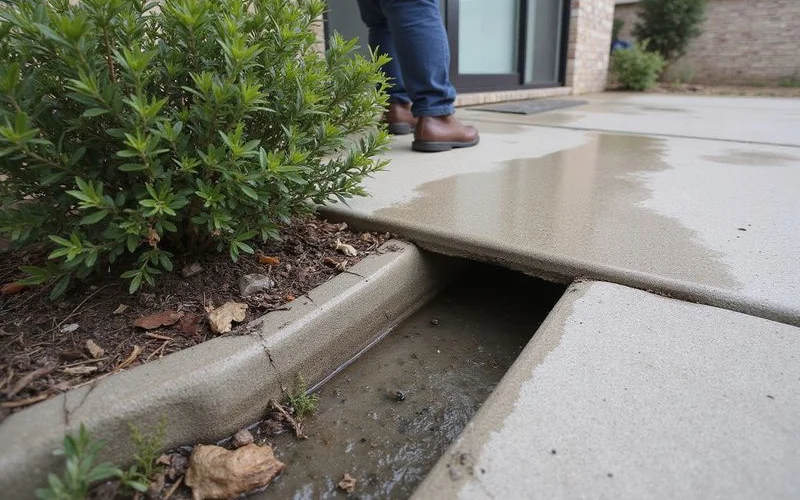
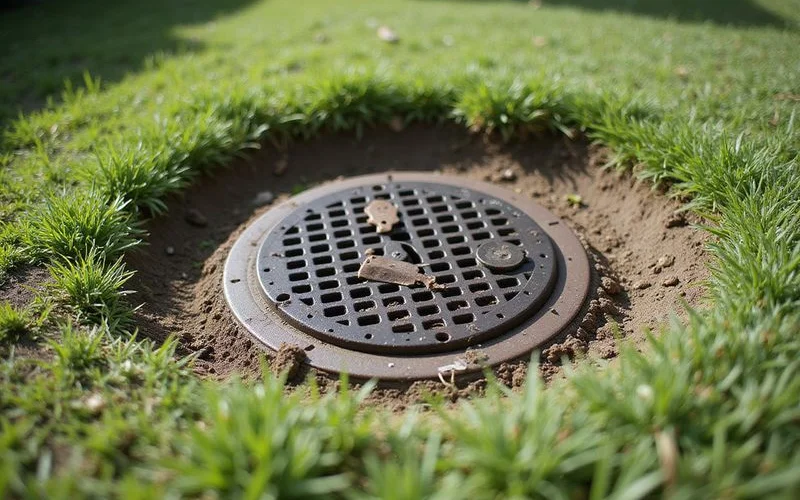
Basins set flush in low points, connected to solid pipe, collecting water running across the surface before it soaks in.
A catch basin handles surface water. Many properties need both, installed as a combined system: basins at the low points, tied into a run that carries water away.
Swales
Shaped depressions across a yard that guide surface water along an intended path rather than letting it find its own. Less visible than pipework and often effective where there is room for them.
Regrading
Restoring fall away from the structure where grade has settled, or where beds have been topped up until the fall reversed. Sometimes the simplest correction available.
Downspout and gutter extensions
Moving concentrated roof discharge away from the foundation. The cheapest and frequently the most effective single intervention — a roof collects a large volume of water and concentrates it at a handful of points.
Sump basin and pump
Where gravity discharge is not available, water is collected in a basin and pumped to an outlet. Mechanical equipment with a service life, so it needs to be accounted for in maintenance.
The First Design Question
Where does the water go?
A drain is only as good as its outlet. The options are gravity discharge to a lower point on the property, connection to a storm system where one exists and connection is permitted, or a sump basin with a pump.
Two constraints:
Capacity. An outlet that cannot handle the flow the system collects backs the system up in exactly the rain it was built for. Sizing collection without sizing discharge produces an expensive trench that floods.
Where it goes. Discharging runoff onto a neighbouring property creates a different problem and can create a dispute. Drainage easements, shared infrastructure, and MUD-level responsibility for stormwater across much of the Houston area all come into it.
On a property with genuinely nowhere for water to go, the honest answer is to say so rather than install something that cannot work.
What Drainage Does Not Do
Stated plainly.
It does not repair a foundation. If support has already been lost, correcting drainage does not restore it. Piers do that — see slab foundation repair.
It does not stop clay from moving. Soil still swells and shrinks; drainage reduces how uneven that becomes.
It does not fix a plumbing leak. A leak saturating soil under a slab is a plumbing problem.
It is not permanent or maintenance-free. Outlets block. Basins collect debris. Pumps fail eventually.
Anyone selling you a French drain as a foundation repair is overselling.
What It Does Do
It addresses one meaningful driver of differential movement, which in Houston’s clay is worth doing. On a property where one elevation is persistently saturated and another persistently dry, closing that gap is directly addressing the mechanism.
It is also usually a fraction of the cost of structural repair, which makes it a sensible thing to get right whether or not structural work is in prospect.
Drainage and Watering: Two Halves of One Idea
Homeowners sometimes see these as contradictory. They are not.
Foundation watering keeps soil moisture from dropping too far during dry summers. Drainage keeps it from becoming excessive and uneven during wet periods.
Both aim at the same thing: keeping clay within a reasonable moisture band. A property can need both, and it is common for a house to have a saturated shaded side and a desiccated sunny side simultaneously.
Our maintenance guide covers the routine that ties them together.