
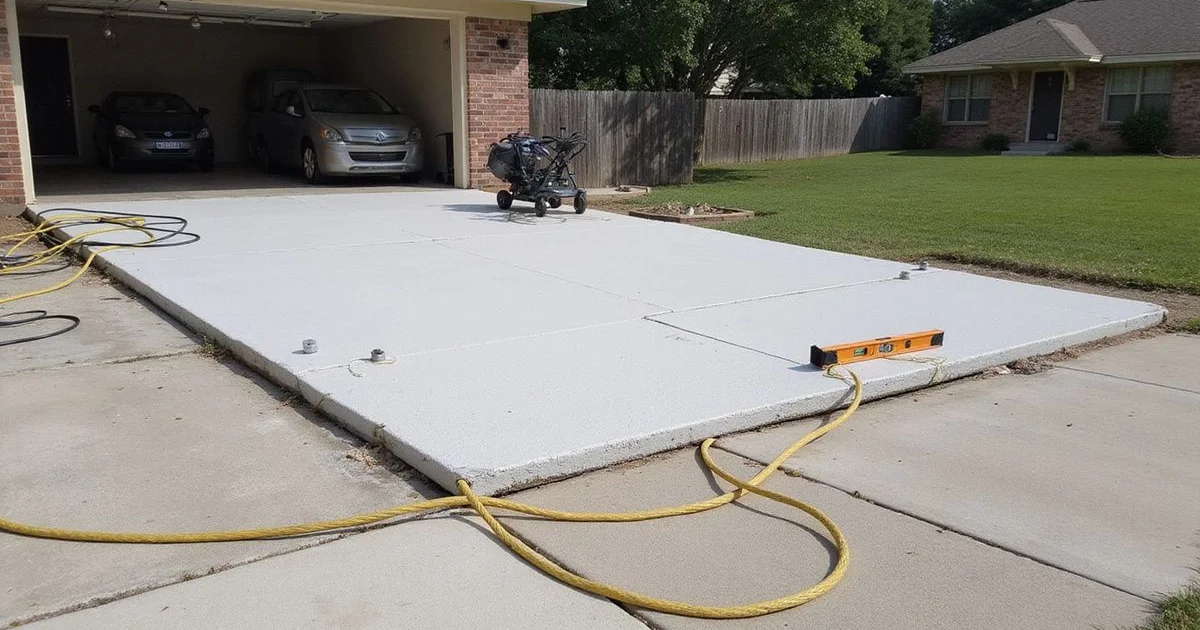
Same Goal, Different Material
Both methods fill the void beneath a settled concrete slab and raise it back toward grade. Neither repairs the concrete itself, and neither addresses whatever caused the settlement.
The difference is what gets injected and how it behaves. Our concrete leveling page covers what the service involves overall; this guide compares the two approaches.
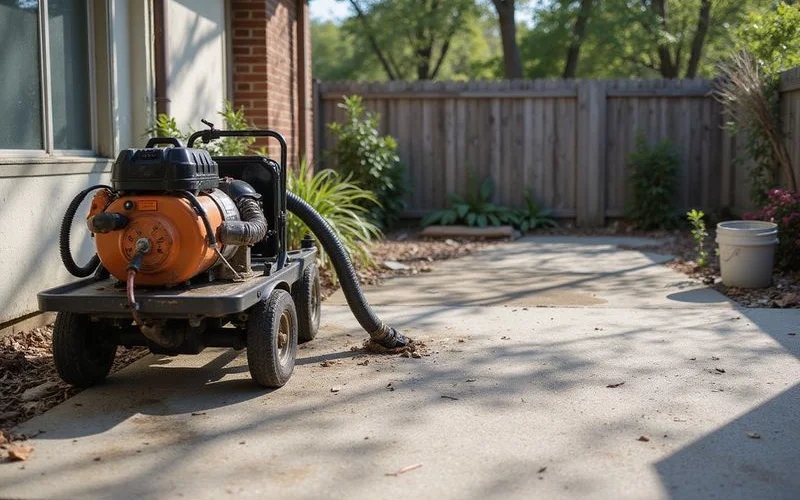
Polyurethane Foam Jacking
A two-part expanding polymer is injected through small ports drilled in the slab. The components react and expand in place, filling the void and lifting the slab as expansion continues.
How it behaves: expands to fill available space, including narrow voids a slurry would struggle to reach. Reaches working strength within minutes.
Weight: light. This matters more than it sounds. Where a subgrade has already demonstrated it cannot support what sits on it, adding a substantial mass of cementitious material is not obviously the right move. Foam adds very little.
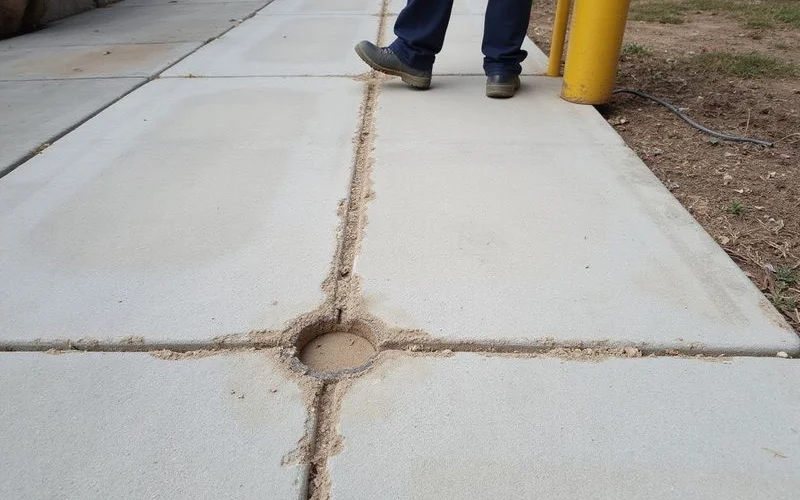
Ports: small, roughly coin-sized, so patching is minimal and relatively unobtrusive.
Return to service: usually the same day, often within a couple of hours. A driveway can normally take vehicle load the same day.
Water: does not absorb water and is not washed out by it in the way some slurry material can be.
Cost: higher material cost per unit volume.
Mudjacking
A cementitious slurry — traditionally a mix of soil, sand, cement, and water — is pumped through larger drilled holes. Its volume fills the void and raises the slab.
How it behaves: flows to fill open voids well; less effective at penetrating very narrow gaps.
Weight: substantially heavier than foam. On a sound subgrade this is unremarkable; on a weak one it is worth considering.
Holes: larger, because slurry needs a wider path. Patches are more visible afterward.
Return to service: longer, because the slurry needs to cure. Typically a day or more depending on conditions and volume.
Water: some slurry mixes can be susceptible to washout where water continues to run under the slab.
Cost: generally lower material cost, and a well-established, widely available method.
Side by Side
| Foam jacking | Mudjacking | |
|---|---|---|
| Material | Expanding polyurethane polymer | Cementitious slurry |
| Cure time | Minutes | A day or more |
| Return to service | Usually same day | Next day or later |
| Weight added | Minimal | Substantial |
| Void penetration | Reaches narrow voids | Better suited to open voids |
| Port size | Small, coin-sized | Larger |
| Patch visibility | Less noticeable | More noticeable |
| Water resistance | Not absorbent | Some mixes susceptible to washout |
| Material cost | Higher | Lower |
| Best suited to | Weak subgrade, fast turnaround, narrow voids, decorative surfaces | Open voids, sound subgrade, cost-sensitive jobs |
Choosing Between Them
The factors that actually decide it:
Subgrade condition. Weak or already-failing subgrade argues for the lighter material.
Void geometry. Narrow, distributed voids favour foam’s expansion. Larger open voids are well served by either.
Turnaround. A driveway that needs to carry a vehicle tonight points clearly toward foam.
Surface finish. Decorative, stamped, or coloured concrete makes patch visibility matter more, favouring the smaller ports.
Water. Where water has been moving under the slab, the washout question favours foam — though the real answer in that situation is addressing the water.
Budget. Mudjacking’s lower material cost is genuine, and on a suitable slab with a sound subgrade it is a perfectly sound choice.
What Neither Method Does
Worth stating plainly:
- Neither repairs the concrete. A cracked slab that gets lifted is a level cracked slab.
- Neither addresses the cause. If subgrade erosion or a leaking line is still washing material out, the void re-forms and the slab settles again.
- Neither is a structural foundation repair. This is flatwork. Your house foundation is a separate matter, covered on our slab foundation repair page.
- Neither works on an unsuitable slab. Badly broken, crumbling, or structurally deteriorated concrete needs replacing, not lifting. Our guide on whether uneven concrete can be leveled covers suitability.
- Neither is permanent, and we will not describe either that way.
The Question Behind the Question
Homeowners usually arrive at this comparison having already decided to lift rather than replace. That decision is usually right, but it is worth checking first.
The suitability assessment comes before the method choice. Is the slab sound enough to raise as a unit? Has whatever caused the settlement stopped? If the answer to either is no, the method comparison is academic.
Once suitability is established, either method may be appropriate, and a contractor should be able to explain why they are proposing the one they are proposing — for your slab, not in general.