
Why the Terms Get Tangled
Three contractors can quote three different scopes under the same word, and a homeowner comparing the numbers assumes they are comparing the same work.
“House leveling” is used loosely across this industry. Sometimes it means a full structural project including installed piers and a controlled lift. Sometimes it means adjusting existing supports on a raised foundation without touching what is beneath them. Sometimes it is used as a general synonym for foundation repair.
Those are materially different scopes at materially different prices. This guide separates them.

The Definitions
Foundation repair is the category. It covers any work addressing the foundation and its support: installing piers to transfer load to a stable bearing layer, repairing or replacing deteriorated structural members, resetting failed supports, and correcting conditions driving movement.
House leveling is an objective within that category. It is specifically the act of raising portions of a structure back toward a target elevation so the floor plane sits within the structure’s tolerance.
So leveling is a subset. Our house leveling page covers what the lift involves; the underpinning that often precedes it sits under slab foundation repair or pier-and-beam repair depending on the foundation type.
Where They Overlap and Where They Do Not
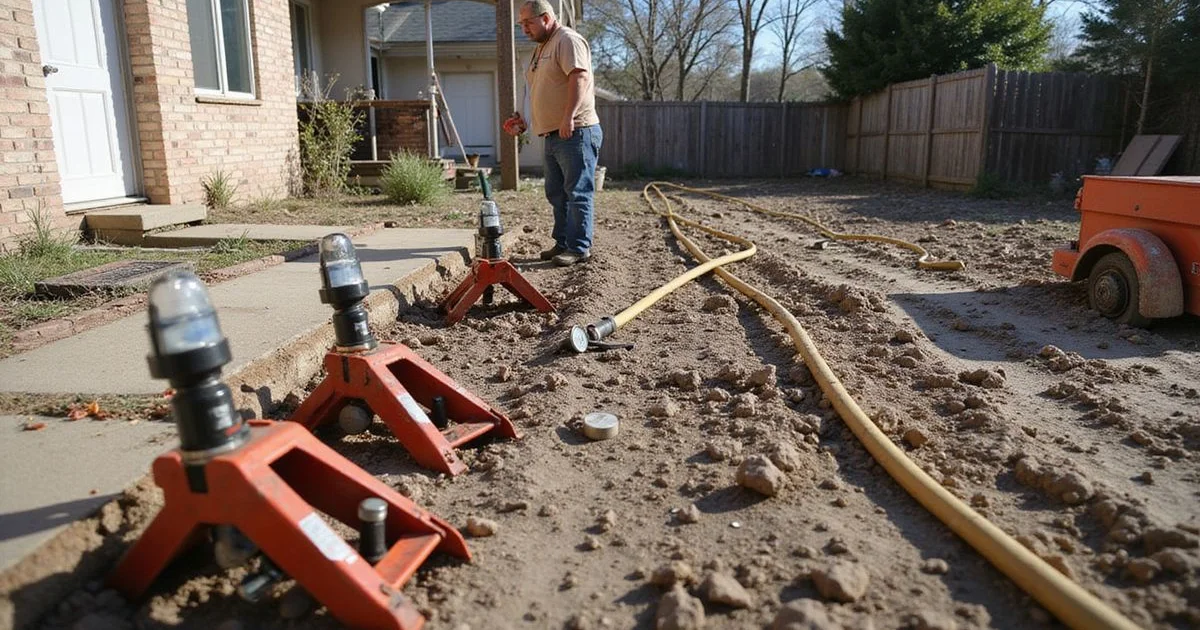
Both together — the common case. Piers are installed to restore support, then the structure is lifted to recover position. Most slab projects with meaningful differential fall here.
Repair without meaningful lift. Where the priority is stopping further movement rather than recovering position, or where the structure’s tolerance does not allow much lift, piers are installed and the lift is minimal or nil. This is a legitimate scope and sometimes the right one.
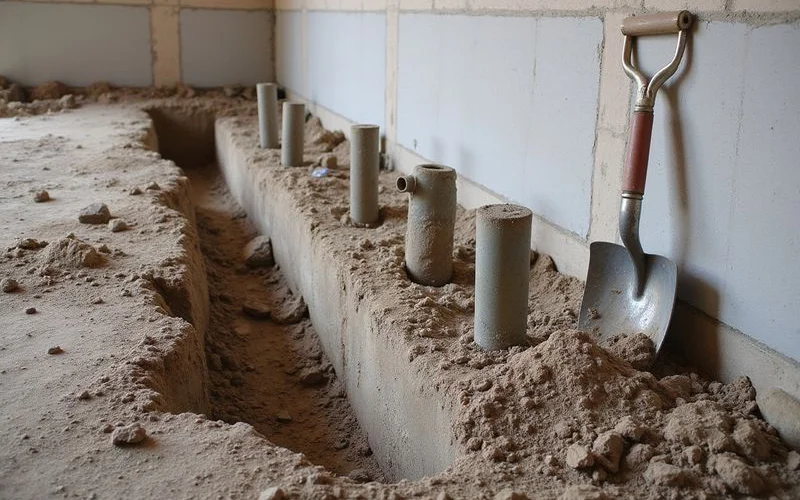
Leveling without underpinning. On a raised foundation, adjusting existing supports — shimming, resetting pier caps — can recover a floor plane without installing anything new beneath. Where the piers are sound and only bearing has been lost, this is exactly the right scope and it is far cheaper than a project involving new supports.
Cause correction without either. Sometimes the finding is that drainage, a leak, or root-driven moisture loss is the issue and the structure has not moved enough to warrant lifting. Drainage work and monitoring is then the answer.
The Distinction That Matters Most
Leveling restores position. It does not automatically address why the position changed.
If a slab dropped at one corner because soil there dried out repeatedly under a large tree, lifting that corner recovers the position. The tree is still there. The drying still happens. Unless the lift was accompanied by support that carries load below the active zone, or by correcting the moisture condition, the driver continues.
This is why an evaluation records site conditions alongside the elevation survey, and why a proposal should state whether it addresses cause, position, or both.
Any quote that promises a level house without saying anything about what caused the differential is describing half a project.
Reading a Quote That Says “Leveling”
Ask these:
- What exactly is being lifted? Which sections, which runs?
- By how much? What is the target elevation plan, and what does the survey show now?
- By what method? Multi-point synchronised jacking, staged? Over what period?
- Is new support being installed, or are existing supports being adjusted?
- What addresses the cause? Or does the scope explicitly not address it?
- What finish work follows? Doors re-hung, trim adjusted, patching — included or excluded?
- What is the honest outcome expectation? Within tolerance, not flat.
A proposal that answers all seven is comparable to another that answers all seven. Our comparison worksheet covers the full set of items.
Cost Implications
Because the scopes differ so much, so do the numbers.
Adjusting existing supports on a raised foundation is at the modest end. Installing piers and lifting a slab across multiple elevations is at the other. A project that also corrects drainage, replaces deteriorated framing, or involves plumbing testing sits higher again.
The cost-factor guide covers what moves the number in each case.
What to Say When You Call
Describe what you are seeing rather than naming a service.
“My floors slope toward the back of the house, two doors have stopped latching, and there is a crack above the patio door” produces a far more useful conversation than “I need house leveling” — because the second presupposes an answer that has not been established yet.
The answer comes from a foundation evaluation: the elevation survey establishes what the floor plane is doing, the distress mapping establishes whether it is consistent, and the site conditions suggest why. Whether the scope that follows is called leveling, repair, or both is a naming question that resolves itself once the findings exist.